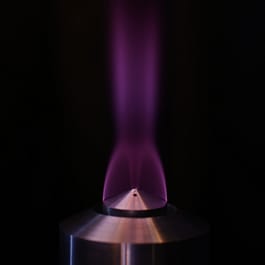

Als Beitrag zur Entwicklung zukünftiger sparsamerer Gasturbinen werden in unserem Labor Stabilisations- und Verlöschmechanismen in turbulenten Flammen untersucht. Die Interaktion zwischen der Strömung und der chemischen Reaktion soll dazu unter realen Bedingungen erforscht werden. Unsere Daten werden dazu verwendet, um anschließend numerische Modelle zu verbessern und Testbrenner für Gasturbinen zu entwickeln. Mehr hierzu...
Die Speicherung erneuerbarer Energie ist ein zentrales Thema der Energiewende. In Zusammenarbeit mit der TU Darmstadt erforschen wir Eisen als Energieträger. Reduktion speichert Energie, Verbrennung setzt sie frei. Einflussfaktoren wie Partikeleigenschaften und Umgebungsbedingungen werden mit Laserdiagnostik und Simulationsansätzen untersucht und modelliert. Mehr hierzu...
Die Raman-Spektroskopie ermöglicht es, durch Licht-Materie-Interaktion chemische Prozesse zu analysieren, ohne diese zu beeinflussen. Allerdings ist die Signalintensität äußerst niedrig und wird von Hintergründen, wie Fluoreszenz oder Wärmestrahlung überlagert. In diesem Projekt wird erforscht, ob mit der Raman-Technik SERDS auch in herausfordernden Bedingungen präzise quantitative Messungen durchgeführt werden können. Mehr hierzu...
Die Chemieindustrie zählt zu den energieintensivsten Sektoren und ist stark von fossilen Rohstoffen abhängig. Ein wichtiger Schritt zur nachhaltigen Transformation ist die Entwicklung umweltfreundlicher Prozesse, die erneuerbare Rohstoffe und wirtschaftliche Katalysatoren nutzen. Mit einem Raman-Spektrometer und IR-Thermografie analysieren wir Gaskonzentrationen, Temperaturen und Prozessbedingungen, ergänzt durch CFD-Simulationen. Mehr hierzu...
Ammoniak (NH3) ist ein kohlenstofffreier Energieträger mit Vorteilen bei Transport und Lagerung gegenüber Wasserstoff. Wasserstoff wird jedoch als Additiv genutzt, um die Verbrennung zu beschleunigen, wobei partielles Cracking NH3 in H2 und N2 spaltet. Ziel unserer Forschung ist es, quantitative Daten zur Ammoniak-Verbrennung zu generieren und die Bildung von Stickoxiden besser zu verstehen. Mehr hierzu...
Die Mischgeschwindigkeit ist ein zentraler Faktor chemischer Verfahren und beeinflusst Produktausbeute und Abfallmenge. Besonders bei schnellen Reaktionen sind Mikrovermischungen vorteilhaft, da sie Vermischungen deutlich schneller als herkömmliche Techniken ermöglichen. Mikroinjektion injiziert Flüssigkeiten in eine turbulente Mischzone, wobei kleine Wirbel die Vermischungsgeschwindigkeit erhöhen. Mehr hierzu...
Die Raman-Spektroskopie detektiert Spezies und Temperaturen zeit- und ortsaufgelöst und ist ein wichtiges Werkzeug zur Analyse zum Beispiel von Verbrennungsprozessen regenerativer Kraftstoffe. Quantenmechanische Simulationen sind notwendig, um die Spektren zu quantifizieren und deren Form sowie Temperatur- und Druckabhängigkeit zu verstehen. Mehr hierzu...
Die Raman-Spektroskopie misst Stoffkonzentrationen in Strömungen, da jede Molekülspezies ein einzigartiges Spektrum besitzt. Die Spektren überlagern sich jedoch, was die Auswertung bei schwachen Signalen erschwert. Ziel des Projekts ist die Weiterentwicklung der Auswertetechnik mithilfe experimenteller Daten und maschinellem Lernen, um die Methode robuster zu machen. Mehr hierzu...
Richter, M.; Lill, J.; Barlow, R. S.; Gruber, A.; Dreizler, A.; Dawson, J. R.; D., Geyer
In: Combustion and Flame, Bd. 277, S. 114139, 2025.
@article{Richter.2025,

title = {Quantification of NO in the post-flame region of laminar premixed ammonia/hydrogen/nitrogen-air flames using laser induced fluorescence},

author = {M. Richter and J. Lill and R. S. Barlow and A. Gruber and A. Dreizler and J. R. Dawson and D., Geyer},

doi = {10.1016/j.combustflame.2025.114139},

year  = {2025},

date = {2025-04-16},

urldate = {2025-04-16},

journal = {Combustion and Flame},

volume = {277},

pages = {114139},

keywords = {},

pubstate = {published},

tppubtype = {article}

}
Lill, Johannes; Dreizler, Andreas; Magnotti, Gaetano; Geyer, Dirk
Accurate simulation of spontaneous Raman scattering of CO2 for high-temperature diagnostics Artikel
In: Journal of Quantitative Spectroscopy and Radiative Transfer, Bd. 330, S. 109223, 2025, ISSN: 00224073.
@article{Lill.2025,

title = {Accurate simulation of spontaneous Raman scattering of CO2 for high-temperature diagnostics},

author = {Johannes Lill and Andreas Dreizler and Gaetano Magnotti and Dirk Geyer},

doi = {10.1016/j.jqsrt.2024.109223},

issn = {00224073},

year  = {2025},

date = {2025-01-01},

journal = {Journal of Quantitative Spectroscopy and Radiative Transfer},

volume = {330},

pages = {109223},

abstract = {Journal of Quantitative Spectroscopy and Radiative Transfer, 330 (2025) 109223. doi:10.1016/j.jqsrt.2024.109223},

keywords = {},

pubstate = {published},

tppubtype = {article}

}
Koschnick, Konrad; Ferris, Alison M.; Lill, Johannes; Stark, Marcel; Winkler, Nico; Weinmann, Andreas; Dreizler, Andreas; Geyer, Dirk
Dual-track spectrometer design for 1D gas-phase Raman spectroscopy Artikel
In: Optics Express, Bd. 32, Nr. 14, S. 24384, 2024.
@article{Koschnick.2024,

title = {Dual-track spectrometer design for 1D gas-phase Raman spectroscopy},

author = {Konrad Koschnick and Alison M. Ferris and Johannes Lill and Marcel Stark and Nico Winkler and Andreas Weinmann and Andreas Dreizler and Dirk Geyer},

doi = {10.1364/OE.523437},

year  = {2024},

date = {2024-01-01},

journal = {Optics Express},

volume = {32},

number = {14},

pages = {24384},

keywords = {},

pubstate = {published},

tppubtype = {article}

}
Dübal, Sören; Berkel, Leon L.; Debiagi, Paulo; Nicolai, Hendrik; Faravelli, Tiziano; Hasse, Christian; Hartl, Sandra
Chemical reactor network modeling in the context of solid fuel combustion under oxy-fuel atmospheres Artikel
In: Fuel, Bd. 364, S. 131096, 2024, ISSN: 00162361.
@article{Dubal.2024,

title = {Chemical reactor network modeling in the context of solid fuel combustion under oxy-fuel atmospheres},

author = {Sören Dübal and Leon L. Berkel and Paulo Debiagi and Hendrik Nicolai and Tiziano Faravelli and Christian Hasse and Sandra Hartl},

doi = {10.1016/j.fuel.2024.131096},

issn = {00162361},

year  = {2024},

date = {2024-01-01},

journal = {Fuel},

volume = {364},

pages = {131096},

keywords = {},

pubstate = {published},

tppubtype = {article}

}
Lill, Johannes; Stark, Marcel; Schultheis, Robin; Weinmann, Andreas; Dreizler, Andreas; Geyer, Dirk
Towards non-intrusive, quantitative N2O Raman measurements in ammonia flames Artikel
In: Proceedings of the Combustion Institute, Bd. 40, Nr. 1-4, S. 105458, 2024, ISSN: 15407489.
@article{Lill.2024,

title = {Towards non-intrusive, quantitative N2O Raman measurements in ammonia flames},

author = {Johannes Lill and Marcel Stark and Robin Schultheis and Andreas Weinmann and Andreas Dreizler and Dirk Geyer},

doi = {10.1016/j.proci.2024.105458},

issn = {15407489},

year  = {2024},

date = {2024-01-01},

journal = {Proceedings of the Combustion Institute},

volume = {40},

number = {1-4},

pages = {105458},

keywords = {},

pubstate = {published},

tppubtype = {article}

}
Schultheis, Robin; Li, Tao; Shi, Shuguo; Barlow, Robert S.; Zhou, Bo; Geyer, Dirk; Dreizler, Andreas
In: Proceedings of the Combustion Institute, Bd. 40, Nr. 1-4, S. 105571, 2024, ISSN: 15407489.
@article{Schultheis.2024,

title = {Quantitative measurements of thermo-chemical states in turbulent lean and rich premixed NH3/H2/N2-air jet flames},

author = {Robin Schultheis and Tao Li and Shuguo Shi and Robert S. Barlow and Bo Zhou and Dirk Geyer and Andreas Dreizler},

url = {https://www.sciencedirect.com/science/article/pii/S1540748924003791},

doi = {10.1016/j.proci.2024.105571},

issn = {15407489},

year  = {2024},

date = {2024-01-01},

journal = {Proceedings of the Combustion Institute},

volume = {40},

number = {1-4},

pages = {105571},

abstract = {Premixed piloted jet flames are an ideal generic configuration to examine the impact of turbulence on thermo-chemical states for staged-combustion systems, like rich-quench-lean technologies, which have been proposed for ammonia combustion to minimize emissions. The current study aims to gain fundamental insights on the internal scalar structure of such premixed and rich-lean stratified ammonia-hydrogen flames. Turbulent premixed NH3/H2/N2-air jet flames, stabilized by a large, lean pilot flame (ϕ<math><mi is=textquotedbltruetextquotedbl>ϕ</mi></math> ~=~0.57), were investigated over a range of lean to rich global equivalence ratios (ϕglobal<math><msub is=textquotedbltruetextquotedbl><mrow is=textquotedbltruetextquotedbl><mi is=textquotedbltruetextquotedbl>ϕ</mi></mrow><mrow is=textquotedbltruetextquotedbl><mi mathvariant=textquotedblnormaltextquotedbl is=textquotedbltruetextquotedbl>global</mi></mrow></msub></math> ~=~0.8, 1.2, and 1.6), employing simultaneous 1D Raman/Rayleigh spectroscopy with a novel calibration approach for NH3. The quantitative scalar data of instantaneous flame structures and thermo-chemical states are analyzed with emphasis on the NH3–H2 interaction and its effects on differential diffusion. In the transition from lean to rich jet flames, the spatial flame structures reveal the presence of residual H2 in the products, while a significant minimization of the NH3 slip is observed. The remaining H2 undergoes turbulent mixing with the hot exhaust gas causing additional heat release and elevated temperatures compared to 1D adiabatic flame simulations. The local oxygen concentration is found to be a determining factor in the interaction between thermal cracking and oxidation of NH3. Due to the formation of H2 as a result of NH3 cracking on the one hand and the oxidation reactions and diffusion of H2 on the other hand, a relatively high H2 concentration is still observed at relatively high temperatures despite the presence of O2. This interplay between in situ cracking, diffusion, turbulent mixing, and oxidation reactions leads to a zone of stratified combustion, so that overall a two-stage combustion characteristic is observed, showing premixed combustion primarily within the jet flow and stratified combustion in the mixing zone with the pilot exhaust gas.},

keywords = {},

pubstate = {published},

tppubtype = {article}

}
Shi, Shuguo; Schultheis, Robin; Barlow, Robert S.; Geyer, Dirk; Dreizler, Andreas; Li, Tao
Internal flame structures of thermo-diffusive lean premixed H2/air flames with increasing turbulence Artikel
In: Proceedings of the Combustion Institute, Bd. 40, Nr. 1-4, S. 105225, 2024, ISSN: 15407489.
@article{Shi.2024,

title = {Internal flame structures of thermo-diffusive lean premixed H2/air flames with increasing turbulence},

author = {Shuguo Shi and Robin Schultheis and Robert S. Barlow and Dirk Geyer and Andreas Dreizler and Tao Li},

url = {https://www.sciencedirect.com/science/article/pii/S154074892400035X},

doi = {10.1016/j.proci.2024.105225},

issn = {15407489},

year  = {2024},

date = {2024-01-01},

journal = {Proceedings of the Combustion Institute},

volume = {40},

number = {1-4},

pages = {105225},

abstract = {Turbulent flow fields, instantaneous flame structures, and internal thermo-chemical states of lean premixed hydrogen/air jet flames at an initial equivalence ratio of 0.4 are experimentally investigated by simultaneous laser-induced fluorescence of hydroxyl radicals (OH-LIF) and particle image velocimetry (PIV), and quasi-simultaneous 1D Raman/Rayleigh and 2D Rayleigh scattering measurements over a range of Karlovitz numbers (Ka) from 50 to 730. At low Ka, intense burning characterized by elevated local equivalence ratio, high water mole fraction (XH2O<math><msub is=textquotedbltruetextquotedbl><mrow is=textquotedbltruetextquotedbl><mi is=textquotedbltruetextquotedbl>X</mi></mrow><mrow is=textquotedbltruetextquotedbl><msub is=textquotedbltruetextquotedbl><mrow is=textquotedbltruetextquotedbl><mi mathvariant=textquotedblnormaltextquotedbl is=textquotedbltruetextquotedbl>H</mi></mrow><mrow is=textquotedbltruetextquotedbl><mn is=textquotedbltruetextquotedbl>2</mn></mrow></msub><mi mathvariant=textquotedblnormaltextquotedbl is=textquotedbltruetextquotedbl>O</mi></mrow></msub></math>), and super-adiabatic flame temperature is mainly observed in post-flame regions surrounded by positively curved flame surfaces, where the fast diffusive hydrogen is locally focused. The flame features stronger differential diffusion and curvature effects than that in the planar laminar flame, which indicates that both molecular and turbulent mixing play significant roles, and thermo-diffusive instabilities have synergistic interactions with turbulence at low turbulence level. With increasing Ka, the burning intensity in corresponding regions is weakened, even though the flame surface is more disturbed by the turbulence. At the highest Ka, no intense burning region is observed in the jet flame as the turbulent transport dominates over the molecular diffusion. In the temperature domain, the conditional means of hydrogen mole fraction (XH2<math><msub is=textquotedbltruetextquotedbl><mrow is=textquotedbltruetextquotedbl><mi is=textquotedbltruetextquotedbl>X</mi></mrow><mrow is=textquotedbltruetextquotedbl><msub is=textquotedbltruetextquotedbl><mrow is=textquotedbltruetextquotedbl><mi mathvariant=textquotedblnormaltextquotedbl is=textquotedbltruetextquotedbl>H</mi></mrow><mrow is=textquotedbltruetextquotedbl><mn is=textquotedbltruetextquotedbl>2</mn></mrow></msub></mrow></msub></math>) and local equivalence ratio feature effects of diffusive instabilities with broad distributions at low-Ka conditions. Elevated XH2O<math><msub is=textquotedbltruetextquotedbl><mrow is=textquotedbltruetextquotedbl><mi is=textquotedbltruetextquotedbl>X</mi></mrow><mrow is=textquotedbltruetextquotedbl><msub is=textquotedbltruetextquotedbl><mrow is=textquotedbltruetextquotedbl><mi mathvariant=textquotedblnormaltextquotedbl is=textquotedbltruetextquotedbl>H</mi></mrow><mrow is=textquotedbltruetextquotedbl><mn is=textquotedbltruetextquotedbl>2</mn></mrow></msub><mi mathvariant=textquotedblnormaltextquotedbl is=textquotedbltruetextquotedbl>O</mi></mrow></msub></math> and local equivalence ratios with super-adiabatic flame temperatures are observed, which is attributed to differential diffusion in hydrogen-containing mixtures and the fuel focusing effect near positively curved flame surfaces. At high Ka, the XH2<math><msub is=textquotedbltruetextquotedbl><mrow is=textquotedbltruetextquotedbl><mi is=textquotedbltruetextquotedbl>X</mi></mrow><mrow is=textquotedbltruetextquotedbl><msub is=textquotedbltruetextquotedbl><mrow is=textquotedbltruetextquotedbl><mi mathvariant=textquotedblnormaltextquotedbl is=textquotedbltruetextquotedbl>H</mi></mrow><mrow is=textquotedbltruetextquotedbl><mn is=textquotedbltruetextquotedbl>2</mn></mrow></msub></mrow></msub></math> shows a more linear decreasing trend and the local equivalence ratio profile becomes flatter over temperature with a narrower distribution, indicating the dominance of turbulent mixing.},

keywords = {},

pubstate = {published},

tppubtype = {article}

}
Shi, Shuguo; Breicher, Adrian; Trabold, Johannes; Hartl, Sandra; Barlow, Robert S.; Dreizler, Andreas; Geyer, Dirk
Cellular structures of laminar lean premixed H2/CH4/air polyhedral flames Artikel
In: Applications in Energy and Combustion Science, Bd. 13, S. 100105, 2023.
@article{Shi.2023,

title = {Cellular structures of laminar lean premixed H2/CH4/air polyhedral flames},

author = {Shuguo Shi and Adrian Breicher and Johannes Trabold and Sandra Hartl and Robert S. Barlow and Andreas Dreizler and Dirk Geyer},

url = {https://www.sciencedirect.com/science/article/pii/S2666352X22000486},

doi = {10.1016/j.jaecs.2022.100105},

year  = {2023},

date = {2023-01-01},

journal = {Applications in Energy and Combustion Science},

volume = {13},

pages = {100105},

abstract = {Fundamental studies on the effects of differential diffusion of hydrogen (H2) on flame structure are motivated as the high diffusivity of H2 presents challenges for the modeling and optimization of combustion systems. Polyhedral Bunsen flames are examples of cellular flames mainly induced by the thermal-diffusive and hydrodynamic instabilities, which are characterized by periodic positively curved troughs and negatively curved cusps. Stationary laminar premixed fuel-lean H2/CH4/air polyhedral flames, with 50%, 68% and 79% H2 (by volume) and Lewis number (Le) less than unity, are investigated in this study. The internal scalar structures of cellular troughs and cusps in target flames are measured with a high-spatial-resolution 1D Raman/Rayleigh scattering system, combined with planar laser-induced fluorescence of hydroxyl radicals (OH-PLIF) and chemiluminescence imaging measurements to quantify the cell number and local flame curvature. The performance of the 1D Raman/Rayleigh imaging system is first assessed by comparing measurements of temperature and major species in a laminar premixed counterflow H2/CH4/air twin flame with a corresponding simulation. The results reveal significant combined effects of differential diffusion and curvature on flame structures with differences between trough and cusp regions in the measured mole fractions, equivalence ratio, temperature, and C/H-atom ratio. The positively curved troughs have significantly higher H2 mole fraction compared to the negatively curved cusps, due to the respective focusing/defocusing effect of curvature on highly diffusive H2. Consequently, the local equivalence ratio and temperature in trough regions are higher than those of cusps. With the increase of H2 content in the reactant mixture, the scalar differences between trough and cusp regions are enlarged due to the enhanced effects of curvature and differential diffusion. Near-vertical initial trajectories in H2 mole fraction, equivalence ratio, and C/H-atom ratio plotted against temperature showed that differential diffusion of H2 alters the species mole fractions in the cold reactants ($łeq$ 350 K).},

keywords = {},

pubstate = {published},

tppubtype = {article}

}
Dieter, K.; Richter, M.; Trabold, J.; Koschnick, K.; Schael, F.; Dreizler, A.; Geyer, D.
Temperature dependent Raman spectra of pure, gaseous formaldehyde for combustion diagnostics Artikel
In: Proceedings of the Combustion Institute, 2023.
@article{Dieter.2022b,

title = {Temperature dependent Raman spectra of pure, gaseous formaldehyde for combustion diagnostics},

author = {K. Dieter and M. Richter and J. Trabold and K. Koschnick and F. Schael and A. Dreizler and D. Geyer},

url = {https://www.sciencedirect.com/science/article/pii/S1540748922003443},

doi = {10.1016/j.proci.2022.08.049},

year  = {2023},

date = {2023-01-01},

journal = {Proceedings of the Combustion Institute},

abstract = {The combustion of renewable fuels such as methanol or ethanol produces comparatively large concentrations of formaldehyde (CH2<math><msub is=textquotedbltruetextquotedbl><mrow is=textquotedbltruetextquotedbl></mrow><mn is=textquotedbltruetextquotedbl>2</mn></msub></math>O) as a combustion intermediate. This intermediate needs to be quantitatively measured using non-intrusive laser diagnostics to provide a better understanding of the chemical processes in the reaction zone. Spontaneous Raman scattering is used in reactive flow diagnostics to measure spatially resolved species concentrations. For diagnostics of CH2<math><msub is=textquotedbltruetextquotedbl><mrow is=textquotedbltruetextquotedbl></mrow><mn is=textquotedbltruetextquotedbl>2</mn></msub></math>O using Raman scattering, the temperature-dependent Raman spectra of gaseous CH2<math><msub is=textquotedbltruetextquotedbl><mrow is=textquotedbltruetextquotedbl></mrow><mn is=textquotedbltruetextquotedbl>2</mn></msub></math>O are required, but not yet available. One reason for this is that gaseous CH2<math><msub is=textquotedbltruetextquotedbl><mrow is=textquotedbltruetextquotedbl></mrow><mn is=textquotedbltruetextquotedbl>2</mn></msub></math>O polymerizes very rapidly, especially at higher temperatures, and can only be made available in pure form for spectroscopic investigations by specific preparation. For this purpose, a continuous flow reactor was developed in which trioxane is pyrolyzed to monomeric CH2<math><msub is=textquotedbltruetextquotedbl><mrow is=textquotedbltruetextquotedbl></mrow><mn is=textquotedbltruetextquotedbl>2</mn></msub></math>O by means of thermal decomposition in a tube reactor. Using a CW-Raman spectrometer, the products of a thermal decomposition at isothermal conditions are analyzed downstream of the tube reactor and CH2<math><msub is=textquotedbltruetextquotedbl><mrow is=textquotedbltruetextquotedbl></mrow><mn is=textquotedbltruetextquotedbl>2</mn></msub></math>O is detected as the only product of the pyrolysis process. Raman spectra of gaseous CH2<math><msub is=textquotedbltruetextquotedbl><mrow is=textquotedbltruetextquotedbl></mrow><mn is=textquotedbltruetextquotedbl>2</mn></msub></math>O are characterized for the first time using the continuous flow system. The Raman scattering in the CH-bend and CH-stretch regions show characteristic bands, which are, for instance, different in the spectral position to the ones from ethanol, allowing for a spectral discrimination. Raman cross sections~reveal that the harmonic-oscillator assumption substantially deviates for the tetratomic CH2<math><msub is=textquotedbltruetextquotedbl><mrow is=textquotedbltruetextquotedbl></mrow><mn is=textquotedbltruetextquotedbl>2</mn></msub></math>O, which underlines the relevance of an experimental characterization at elevated temperatures. Finally, the flow systems developed for the generation of monomeric gaseous CH2<math><msub is=textquotedbltruetextquotedbl><mrow is=textquotedbltruetextquotedbl></mrow><mn is=textquotedbltruetextquotedbl>2</mn></msub></math>O can potentially be employed to improve diagnostics, such as laser induced fluorescence for a quantitative measurement of CH2<math><msub is=textquotedbltruetextquotedbl><mrow is=textquotedbltruetextquotedbl></mrow><mn is=textquotedbltruetextquotedbl>2</mn></msub></math>O.},

keywords = {},

pubstate = {published},

tppubtype = {article}

}
Engelmann, Linus; Wollny, Patrick; Breicher, Adrian; Geyer, Dirk; Chakraborty, Nilanjan; Kempf, Andreas
In: Combustion and Flame, Bd. 251, S. 112718, 2023.
@article{Engelmann.2023,

title = {Numerical analysis of multi-regime combustion using flamelet generated manifolds - a highly-resolved Large-Eddy Simulation of the Darmstadt multi-regime burner},

author = {Linus Engelmann and Patrick Wollny and Adrian Breicher and Dirk Geyer and Nilanjan Chakraborty and Andreas Kempf},

url = {https://www.sciencedirect.com/science/article/pii/S0010218023001037},

doi = {10.1016/j.combustflame.2023.112718},

year  = {2023},

date = {2023-01-01},

journal = {Combustion and Flame},

volume = {251},

pages = {112718},

abstract = {Multi-regime effects occur due to the interaction of combustion phenomena such as partial premixing of reactants or product-recirculation and lead to the invalidity of idealization of local reaction zones by purely premixed or purely non-premixed flame structures. The recently proposed multi-regime burner (MRB) at the Hochschule Darmstadt and the TU Darmstadt is investigated using highly-resolved Large-Eddy Simulation (LES) regarding the present combustion modes – with focus on MILD combustion – and overall flame characteristics. Thermochemical experimental data and highly resolved LES are compared for two selected operating conditions MRB18b and MRB26b. The experimental investigation focuses on the overall flame structure by examining radial profiles of temperature and mixture fraction, as well as scatter plots of temperature and CH4<math><msub is=textquotedbltruetextquotedbl><mrow is=textquotedbltruetextquotedbl></mrow><mn is=textquotedbltruetextquotedbl>4</mn></msub></math> versus mixture fraction. The objective of this analysis is to provide insights into the reaction zone structure which are difficult to extract by experimental means, by using highly-resolved Large-Eddy Simulations under flow conditions representative of MRB18b and MRB26b. The generated database was used to allow for a separate analysis of the inner and outer flame branches. SO2<math><msub is=textquotedbltruetextquotedbl><mrow is=textquotedbltruetextquotedbl></mrow><mn is=textquotedbltruetextquotedbl>2</mn></msub></math> measurements were analyzed together with the simulated temperature fields to further assess the flame stabilization mechanism in this configuration. The importance of different flame zones and burning modes was analyzed using the flame index and temperature locus diagrams. The effects of the flame zones are found to evolve with the downstream distance and show distinct differences between the two operating conditions. The applied diagnostics reveal the spatial and thermodynamical state of the different regimes.},

keywords = {},

pubstate = {published},

tppubtype = {article}

}
Fiorina, Benoît; Luu, Tan Phong; Dillon, Samuel; Mercier, Renaud; Wang, Ping; Angelilli, Lorenzo; Ciottoli, Pietro Paolo; Hernández–Pérez, Francisco E.; Valorani, Mauro; Im, Hong G.; Massey, James C.; Li, Zhiyi; Chen, Zhi X.; Swaminathan, Nedunchezhian; Popp, Sebastian; Hartl, Sandra; Nicolai, Hendrik; Hasse, Christian; Dreizler, Andreas; Butz, David; Geyer, Dirk; Breicher, Adrian; Zhang, Kai; Duwig, Christophe; Zhang, Weijie; Han, Wang; Oijen, Jeroen; Péquin, Arthur; Parente, Alessandro; Engelmann, Linus; Kempf, Andreas; Hansinger, Maximilian; Pfitzner, Michael; Barlow, Robert S.
A joint numerical study of multi-regime turbulent combustion Artikel
In: Applications in Energy and Combustion Science, S. 100221, 2023.
@article{Fiorina.2023,

title = {A joint numerical study of multi-regime turbulent combustion},

author = {Benoît Fiorina and Tan Phong Luu and Samuel Dillon and Renaud Mercier and Ping Wang and Lorenzo Angelilli and Pietro Paolo Ciottoli and Francisco E. Hernández–Pérez and Mauro Valorani and Hong G. Im and James C. Massey and Zhiyi Li and Zhi X. Chen and Nedunchezhian Swaminathan and Sebastian Popp and Sandra Hartl and Hendrik Nicolai and Christian Hasse and Andreas Dreizler and David Butz and Dirk Geyer and Adrian Breicher and Kai Zhang and Christophe Duwig and Weijie Zhang and Wang Han and Jeroen Oijen and Arthur Péquin and Alessandro Parente and Linus Engelmann and Andreas Kempf and Maximilian Hansinger and Michael Pfitzner and Robert S. Barlow},

url = {https://www.sciencedirect.com/science/article/pii/S2666352X23001103},

doi = {10.1016/j.jaecs.2023.100221},

year  = {2023},

date = {2023-01-01},

journal = {Applications in Energy and Combustion Science},

pages = {100221},

abstract = {This article presents a joint numerical study on the Multi Regime Burner configuration. The burner design consists of three concentric inlet streams, which can be operated independently with different equivalence ratios, allowing the operation of stratified flames characterized by different combustion regimes, including premixed, non-premixed, and multi-regime flame zones. Simulations were performed on three LES solvers based on different numerical methods. Combustion kinetics were simplified by using tabulated or reduced chemistry methods. Finally, different turbulent combustion modeling strategies were employed, covering geometrical, statistical, and reactor based approaches. Due to this significant scattering of simulation parameters, a conclusion on specific combustion model performance is impossible. However, with ten numerical groups involved in the numerical simulations, a rough statistical analysis is conducted: the average and the standard deviation of the numerical simulation are computed and compared against experiments. This joint numerical study is therefore a partial illustration of the community's ability to model turbulent combustion. This exercise gives the average performance of current simulations and identifies physical phenomena not well captured today by most modeling strategies. Detailed comparisons between experimental and numerical data along radial profiles taken at different axial positions showed that the temperature field is fairly well captured up to 60 mm from the burner exit. The comparison reveals, however, significant discrepancies regarding CO mass fraction prediction. Three causes may explain this phenomenon. The first reason is the higher sensitivity of carbon monoxide to the simplification of detailed chemistry, especially when multiple combustion regimes are encountered. The second is the bias introduced by artificial thickening, which overestimates the species' mass production rate. This behavior has been illustrated by manufacturing mean thickened turbulent flame brush from a random displacement of 1-D laminar flame solutions. The last one is the influence of the subgrid-scale flame wrinkling on the filtered chemical flame structure, which may be challenging to model.},

keywords = {},

pubstate = {published},

tppubtype = {article}

}
Lill, Johannes; Dieter, Kevin; Koschnick, Konrad; Dreizler, Andreas; Magnotti, Gaetano; Geyer, Dirk
In: Journal of Quantitative Spectroscopy and Radiative Transfer, Bd. 297, S. 108479, 2023.
@article{Lill.2023,

title = {Measurement and simulation of temperature-dependent spontaneous Raman scattering of O2 including P and R branches},

author = {Johannes Lill and Kevin Dieter and Konrad Koschnick and Andreas Dreizler and Gaetano Magnotti and Dirk Geyer},

doi = {10.1016/j.jqsrt.2022.108479},

year  = {2023},

date = {2023-01-01},

journal = {Journal of Quantitative Spectroscopy and Radiative Transfer},

volume = {297},

pages = {108479},

abstract = {Journal of Quantitative Spectroscopy and Radiative Transfer, 297 (2023) 108479. doi:10.1016/j.jqsrt.2022.108479},

keywords = {},

pubstate = {published},

tppubtype = {article}

}
Lulic, Haris; Breicher, Adrian; Scholtissek, Arne; Lapenna, Pasquale Eduardo; Dreizler, Andreas; Creta, Francesco; Hasse, Christian; Geyer, Dirk; Ferraro, Federica
In: Proceedings of the Combustion Institute, Bd. 39, Nr. 2, S. 1977–1986, 2023.
@article{Lulic.2023,

title = {On polyhedral structures of lean methane/hydrogen Bunsen flames: Combined experimental and numerical analysis},

author = {Haris Lulic and Adrian Breicher and Arne Scholtissek and Pasquale Eduardo Lapenna and Andreas Dreizler and Francesco Creta and Christian Hasse and Dirk Geyer and Federica Ferraro},

url = {https://www.sciencedirect.com/science/article/pii/S1540748922003091},

doi = {10.1016/j.proci.2022.07.251},

year  = {2023},

date = {2023-01-01},

journal = {Proceedings of the Combustion Institute},

volume = {39},

number = {2},

pages = {1977–1986},

abstract = {In premixed flame propagation of lean hydrogen or hydrogen-enriched blends, both hydrodynamic and thermo-diffusive instabilities are governing the flame front shape and affect its propagation velocity. As a result, different types of cellular patterns can occur along the flame front in a laminar scenario. In this context, an interesting phenomenon is the formation of polyhedral flames which can be observed in a Bunsen burner. It is the objective of this work to systematically characterize the polyhedral structures of premixed methane/hydrogen Bunsen flames in a combined experimental and numerical study. A series of lean flames with hydrogen content varying between 20 and 85% at two equivalence ratios is investigated. The experiments encompass chemiluminescence imaging together with Planar Laser-induced Fluorescence (PLIF) measurements of the OH radical. Characteristic cell sizes are quantified from the experiments and related to the characteristic length scales obtained from a linear stability analysis. In the experiments, it is observed that the cell sizes at the base of the polyhedral Bunsen flames decrease almost linearly with hydrogen addition and only a weak dependence on the equivalence ratio is noted. These trends are well reflected in the numerical results and the length scale comparison further shows that the wavelength with the maximum growth rate predicted by the linear stability analysis is comparable to the cell size obtained from the experiment. The correlation between the experimental findings and the linear stability analysis is discussed from multiple perspectives considering the governing time and length scales, furthermore drawing relations to previous studies on cellular flames.},

keywords = {},

pubstate = {published},

tppubtype = {article}

}
Luo, Yujuan; Ferraro, Federica; Breicher, Adrian; Böttler, Hannes; Dreizler, Andreas; Geyer, Dirk; Hasse, Christian; Scholtissek, Arne
A novel flamelet manifold parametrization approach for lean CH4–H2-air flames Artikel
In: International Journal of Hydrogen Energy, 2023.
@article{Luo.2023,

title = {A novel flamelet manifold parametrization approach for lean CH4–H2-air flames},

author = {Yujuan Luo and Federica Ferraro and Adrian Breicher and Hannes Böttler and Andreas Dreizler and Dirk Geyer and Christian Hasse and Arne Scholtissek},

url = {https://www.sciencedirect.com/science/article/pii/S0360319922044706},

doi = {10.1016/j.ijhydene.2022.09.233},

year  = {2023},

date = {2023-01-01},

journal = {International Journal of Hydrogen Energy},

abstract = {Hydrogen is a carbon-free energy carrier that can substantially support the decarbonization of the power generation and transportation sector in the near future. Blending H2 into natural gas represents a feasible option to continue using the current infrastructure, allowing a smooth transition to pure H2 combustion technologies. In the present study, a flamelet model is proposed to describe lean CH4–H2-air laminar Bunsen flames with inert gas as a coflow, simultaneously taking into account multiple complex physical phenomena such as differential diffusion, heat losses at the burner wall and mixing between the main flow and coflow. In most previous works based on manifold-based reduction methods, transport equations are solved for the progress variable, mixture fraction and enthalpy. In contrast, transport equations for several species and enthalpy are solved in the present study and species diffusivities are evaluated with a mixture-averaged diffusion model. The control variables of the manifold are then reconstructed with those transported variables. In order to consider the mixing between the main flow and the inert coflow, two different approaches based on a three-dimensional and a four-dimensional manifold, respectively, are formulated and assessed. Utilizing a ``linear mixing'' assumption, the three-dimensional manifold is parameterized by a progress variable, an approximate Bilger mixture fraction and enthalpy. The four-dimensional manifold relaxes this assumption and additionally includes the inert gas mass fraction as the fourth control variable. The accuracy of the two approaches is evaluated by comparison with detailed chemistry results and experimental measurements. Overall, results obtained with both approaches show good agreement with the reference data, both qualitatively and quantitatively, indicating that all the effects mentioned above are well captured. Slightly better agreement is achieved with the four-dimensional manifold, which shows superiority in the mixing layer between the main flow and the inert coflow.},

keywords = {},

pubstate = {published},

tppubtype = {article}

}
Richter, M.; Schultheis, R.; Dawson, J. R.; Gruber, A.; Barlow, R. S.; Dreizler, A.; Geyer, D.
Extinction strain rates of premixed ammonia/hydrogen/nitrogen-air counterflow flames Artikel
In: Proceedings of the Combustion Institute, Bd. 39, Nr. 2, S. 2027–2035, 2023.
@article{Richter.2023,

title = {Extinction strain rates of premixed ammonia/hydrogen/nitrogen-air counterflow flames},

author = {M. Richter and R. Schultheis and J. R. Dawson and A. Gruber and R. S. Barlow and A. Dreizler and D. Geyer},

url = {https://www.sciencedirect.com/science/article/pii/S1540748922003790},

doi = {10.1016/j.proci.2022.09.011},

year  = {2023},

date = {2023-01-01},

journal = {Proceedings of the Combustion Institute},

volume = {39},

number = {2},

pages = {2027–2035},

abstract = {Chemical energy vectors will play a crucial role in the transition of the global energy system, due to their essential advantages in storing energy in form of gaseous, liquid, or solid fuels. Ammonia (NH3) has been identified as a highly promising candidate, as it is carbon-free, can be stored at moderate pressures, and already has a developed distribution infrastructure. As a fuel NH3 has poor combustion properties that can be improved by the addition of hydrogen, which can be obtained energy-efficiently by partially cracking ammonia into hydrogen (H2) and nitrogen (N2) prior to the combustion process. The resulting NH3/H2/N2 blend leads to significantly improved flame stability and resilience to strain-induced blow-out, despite similar laminar flame properties compared to equivalent methane/air flames. This study reports the first measurements of extinction strain rates, measured using the premixed twin-flame configuration in a laminar opposed jet burner, for two NH3/H2/N2 blends over a range of equivalence ratios. Local strain rates are measured using particle tracking velocimetry (PTV) and are related to the inflow conditions, such that the local strain rate at the extinction point can be approximated. The results are compared with 1D-simulations using three recent kinetic mechanisms for ammonia oxidation. By relating the extinction strain rates to laminar flame properties of the unstretched flame, a comparison of the extinction behaviour of CH4 and NH3/H2/N2 blends can be made. For lean mixtures, NH3/H2/N2-air flames show a significant higher extinction resistance in comparison to CH4/air. In addition, a strong non-linear dependence between the resistance to extinction and equivalence ratio for NH3/H2/N2 blends is observed.},

keywords = {},

pubstate = {published},

tppubtype = {article}

}
Richter, M.; Lill, J.; Barlow, R. S.; Gruber, A.; Dreizler, A.; Dawson, J. R.; D., Geyer
In: Combustion and Flame, Bd. 277, S. 114139, 2025.
@article{Richter.2025,

title = {Quantification of NO in the post-flame region of laminar premixed ammonia/hydrogen/nitrogen-air flames using laser induced fluorescence},

author = {M. Richter and J. Lill and R. S. Barlow and A. Gruber and A. Dreizler and J. R. Dawson and D., Geyer},

doi = {10.1016/j.combustflame.2025.114139},

year  = {2025},

date = {2025-04-16},

urldate = {2025-04-16},

journal = {Combustion and Flame},

volume = {277},

pages = {114139},

keywords = {},

pubstate = {published},

tppubtype = {article}

}
Lill, Johannes; Dreizler, Andreas; Magnotti, Gaetano; Geyer, Dirk
Accurate simulation of spontaneous Raman scattering of CO2 for high-temperature diagnostics Artikel
In: Journal of Quantitative Spectroscopy and Radiative Transfer, Bd. 330, S. 109223, 2025, ISSN: 00224073.
@article{Lill.2025,

title = {Accurate simulation of spontaneous Raman scattering of CO2 for high-temperature diagnostics},

author = {Johannes Lill and Andreas Dreizler and Gaetano Magnotti and Dirk Geyer},

doi = {10.1016/j.jqsrt.2024.109223},

issn = {00224073},

year  = {2025},

date = {2025-01-01},

journal = {Journal of Quantitative Spectroscopy and Radiative Transfer},

volume = {330},

pages = {109223},

abstract = {Journal of Quantitative Spectroscopy and Radiative Transfer, 330 (2025) 109223. doi:10.1016/j.jqsrt.2024.109223},

keywords = {},

pubstate = {published},

tppubtype = {article}

}
Koschnick, Konrad; Ferris, Alison M.; Lill, Johannes; Stark, Marcel; Winkler, Nico; Weinmann, Andreas; Dreizler, Andreas; Geyer, Dirk
Dual-track spectrometer design for 1D gas-phase Raman spectroscopy Artikel
In: Optics Express, Bd. 32, Nr. 14, S. 24384, 2024.
@article{Koschnick.2024,

title = {Dual-track spectrometer design for 1D gas-phase Raman spectroscopy},

author = {Konrad Koschnick and Alison M. Ferris and Johannes Lill and Marcel Stark and Nico Winkler and Andreas Weinmann and Andreas Dreizler and Dirk Geyer},

doi = {10.1364/OE.523437},

year  = {2024},

date = {2024-01-01},

journal = {Optics Express},

volume = {32},

number = {14},

pages = {24384},

keywords = {},

pubstate = {published},

tppubtype = {article}

}
Dübal, Sören; Berkel, Leon L.; Debiagi, Paulo; Nicolai, Hendrik; Faravelli, Tiziano; Hasse, Christian; Hartl, Sandra
Chemical reactor network modeling in the context of solid fuel combustion under oxy-fuel atmospheres Artikel
In: Fuel, Bd. 364, S. 131096, 2024, ISSN: 00162361.
@article{Dubal.2024,

title = {Chemical reactor network modeling in the context of solid fuel combustion under oxy-fuel atmospheres},

author = {Sören Dübal and Leon L. Berkel and Paulo Debiagi and Hendrik Nicolai and Tiziano Faravelli and Christian Hasse and Sandra Hartl},

doi = {10.1016/j.fuel.2024.131096},

issn = {00162361},

year  = {2024},

date = {2024-01-01},

journal = {Fuel},

volume = {364},

pages = {131096},

keywords = {},

pubstate = {published},

tppubtype = {article}

}
Lill, Johannes; Stark, Marcel; Schultheis, Robin; Weinmann, Andreas; Dreizler, Andreas; Geyer, Dirk
Towards non-intrusive, quantitative N2O Raman measurements in ammonia flames Artikel
In: Proceedings of the Combustion Institute, Bd. 40, Nr. 1-4, S. 105458, 2024, ISSN: 15407489.
@article{Lill.2024,

title = {Towards non-intrusive, quantitative N2O Raman measurements in ammonia flames},

author = {Johannes Lill and Marcel Stark and Robin Schultheis and Andreas Weinmann and Andreas Dreizler and Dirk Geyer},

doi = {10.1016/j.proci.2024.105458},

issn = {15407489},

year  = {2024},

date = {2024-01-01},

journal = {Proceedings of the Combustion Institute},

volume = {40},

number = {1-4},

pages = {105458},

keywords = {},

pubstate = {published},

tppubtype = {article}

}
Schultheis, Robin; Li, Tao; Shi, Shuguo; Barlow, Robert S.; Zhou, Bo; Geyer, Dirk; Dreizler, Andreas
In: Proceedings of the Combustion Institute, Bd. 40, Nr. 1-4, S. 105571, 2024, ISSN: 15407489.
@article{Schultheis.2024,

title = {Quantitative measurements of thermo-chemical states in turbulent lean and rich premixed NH3/H2/N2-air jet flames},

author = {Robin Schultheis and Tao Li and Shuguo Shi and Robert S. Barlow and Bo Zhou and Dirk Geyer and Andreas Dreizler},

url = {https://www.sciencedirect.com/science/article/pii/S1540748924003791},

doi = {10.1016/j.proci.2024.105571},

issn = {15407489},

year  = {2024},

date = {2024-01-01},

journal = {Proceedings of the Combustion Institute},

volume = {40},

number = {1-4},

pages = {105571},

abstract = {Premixed piloted jet flames are an ideal generic configuration to examine the impact of turbulence on thermo-chemical states for staged-combustion systems, like rich-quench-lean technologies, which have been proposed for ammonia combustion to minimize emissions. The current study aims to gain fundamental insights on the internal scalar structure of such premixed and rich-lean stratified ammonia-hydrogen flames. Turbulent premixed NH3/H2/N2-air jet flames, stabilized by a large, lean pilot flame (ϕ<math><mi is=textquotedbltruetextquotedbl>ϕ</mi></math> ~=~0.57), were investigated over a range of lean to rich global equivalence ratios (ϕglobal<math><msub is=textquotedbltruetextquotedbl><mrow is=textquotedbltruetextquotedbl><mi is=textquotedbltruetextquotedbl>ϕ</mi></mrow><mrow is=textquotedbltruetextquotedbl><mi mathvariant=textquotedblnormaltextquotedbl is=textquotedbltruetextquotedbl>global</mi></mrow></msub></math> ~=~0.8, 1.2, and 1.6), employing simultaneous 1D Raman/Rayleigh spectroscopy with a novel calibration approach for NH3. The quantitative scalar data of instantaneous flame structures and thermo-chemical states are analyzed with emphasis on the NH3–H2 interaction and its effects on differential diffusion. In the transition from lean to rich jet flames, the spatial flame structures reveal the presence of residual H2 in the products, while a significant minimization of the NH3 slip is observed. The remaining H2 undergoes turbulent mixing with the hot exhaust gas causing additional heat release and elevated temperatures compared to 1D adiabatic flame simulations. The local oxygen concentration is found to be a determining factor in the interaction between thermal cracking and oxidation of NH3. Due to the formation of H2 as a result of NH3 cracking on the one hand and the oxidation reactions and diffusion of H2 on the other hand, a relatively high H2 concentration is still observed at relatively high temperatures despite the presence of O2. This interplay between in situ cracking, diffusion, turbulent mixing, and oxidation reactions leads to a zone of stratified combustion, so that overall a two-stage combustion characteristic is observed, showing premixed combustion primarily within the jet flow and stratified combustion in the mixing zone with the pilot exhaust gas.},

keywords = {},

pubstate = {published},

tppubtype = {article}

}
Shi, Shuguo; Schultheis, Robin; Barlow, Robert S.; Geyer, Dirk; Dreizler, Andreas; Li, Tao
Internal flame structures of thermo-diffusive lean premixed H2/air flames with increasing turbulence Artikel
In: Proceedings of the Combustion Institute, Bd. 40, Nr. 1-4, S. 105225, 2024, ISSN: 15407489.
@article{Shi.2024,

title = {Internal flame structures of thermo-diffusive lean premixed H2/air flames with increasing turbulence},

author = {Shuguo Shi and Robin Schultheis and Robert S. Barlow and Dirk Geyer and Andreas Dreizler and Tao Li},

url = {https://www.sciencedirect.com/science/article/pii/S154074892400035X},

doi = {10.1016/j.proci.2024.105225},

issn = {15407489},

year  = {2024},

date = {2024-01-01},

journal = {Proceedings of the Combustion Institute},

volume = {40},

number = {1-4},

pages = {105225},

abstract = {Turbulent flow fields, instantaneous flame structures, and internal thermo-chemical states of lean premixed hydrogen/air jet flames at an initial equivalence ratio of 0.4 are experimentally investigated by simultaneous laser-induced fluorescence of hydroxyl radicals (OH-LIF) and particle image velocimetry (PIV), and quasi-simultaneous 1D Raman/Rayleigh and 2D Rayleigh scattering measurements over a range of Karlovitz numbers (Ka) from 50 to 730. At low Ka, intense burning characterized by elevated local equivalence ratio, high water mole fraction (XH2O<math><msub is=textquotedbltruetextquotedbl><mrow is=textquotedbltruetextquotedbl><mi is=textquotedbltruetextquotedbl>X</mi></mrow><mrow is=textquotedbltruetextquotedbl><msub is=textquotedbltruetextquotedbl><mrow is=textquotedbltruetextquotedbl><mi mathvariant=textquotedblnormaltextquotedbl is=textquotedbltruetextquotedbl>H</mi></mrow><mrow is=textquotedbltruetextquotedbl><mn is=textquotedbltruetextquotedbl>2</mn></mrow></msub><mi mathvariant=textquotedblnormaltextquotedbl is=textquotedbltruetextquotedbl>O</mi></mrow></msub></math>), and super-adiabatic flame temperature is mainly observed in post-flame regions surrounded by positively curved flame surfaces, where the fast diffusive hydrogen is locally focused. The flame features stronger differential diffusion and curvature effects than that in the planar laminar flame, which indicates that both molecular and turbulent mixing play significant roles, and thermo-diffusive instabilities have synergistic interactions with turbulence at low turbulence level. With increasing Ka, the burning intensity in corresponding regions is weakened, even though the flame surface is more disturbed by the turbulence. At the highest Ka, no intense burning region is observed in the jet flame as the turbulent transport dominates over the molecular diffusion. In the temperature domain, the conditional means of hydrogen mole fraction (XH2<math><msub is=textquotedbltruetextquotedbl><mrow is=textquotedbltruetextquotedbl><mi is=textquotedbltruetextquotedbl>X</mi></mrow><mrow is=textquotedbltruetextquotedbl><msub is=textquotedbltruetextquotedbl><mrow is=textquotedbltruetextquotedbl><mi mathvariant=textquotedblnormaltextquotedbl is=textquotedbltruetextquotedbl>H</mi></mrow><mrow is=textquotedbltruetextquotedbl><mn is=textquotedbltruetextquotedbl>2</mn></mrow></msub></mrow></msub></math>) and local equivalence ratio feature effects of diffusive instabilities with broad distributions at low-Ka conditions. Elevated XH2O<math><msub is=textquotedbltruetextquotedbl><mrow is=textquotedbltruetextquotedbl><mi is=textquotedbltruetextquotedbl>X</mi></mrow><mrow is=textquotedbltruetextquotedbl><msub is=textquotedbltruetextquotedbl><mrow is=textquotedbltruetextquotedbl><mi mathvariant=textquotedblnormaltextquotedbl is=textquotedbltruetextquotedbl>H</mi></mrow><mrow is=textquotedbltruetextquotedbl><mn is=textquotedbltruetextquotedbl>2</mn></mrow></msub><mi mathvariant=textquotedblnormaltextquotedbl is=textquotedbltruetextquotedbl>O</mi></mrow></msub></math> and local equivalence ratios with super-adiabatic flame temperatures are observed, which is attributed to differential diffusion in hydrogen-containing mixtures and the fuel focusing effect near positively curved flame surfaces. At high Ka, the XH2<math><msub is=textquotedbltruetextquotedbl><mrow is=textquotedbltruetextquotedbl><mi is=textquotedbltruetextquotedbl>X</mi></mrow><mrow is=textquotedbltruetextquotedbl><msub is=textquotedbltruetextquotedbl><mrow is=textquotedbltruetextquotedbl><mi mathvariant=textquotedblnormaltextquotedbl is=textquotedbltruetextquotedbl>H</mi></mrow><mrow is=textquotedbltruetextquotedbl><mn is=textquotedbltruetextquotedbl>2</mn></mrow></msub></mrow></msub></math> shows a more linear decreasing trend and the local equivalence ratio profile becomes flatter over temperature with a narrower distribution, indicating the dominance of turbulent mixing.},

keywords = {},

pubstate = {published},

tppubtype = {article}

}
Shi, Shuguo; Breicher, Adrian; Trabold, Johannes; Hartl, Sandra; Barlow, Robert S.; Dreizler, Andreas; Geyer, Dirk
Cellular structures of laminar lean premixed H2/CH4/air polyhedral flames Artikel
In: Applications in Energy and Combustion Science, Bd. 13, S. 100105, 2023.
@article{Shi.2023,

title = {Cellular structures of laminar lean premixed H2/CH4/air polyhedral flames},

author = {Shuguo Shi and Adrian Breicher and Johannes Trabold and Sandra Hartl and Robert S. Barlow and Andreas Dreizler and Dirk Geyer},

url = {https://www.sciencedirect.com/science/article/pii/S2666352X22000486},

doi = {10.1016/j.jaecs.2022.100105},

year  = {2023},

date = {2023-01-01},

journal = {Applications in Energy and Combustion Science},

volume = {13},

pages = {100105},

abstract = {Fundamental studies on the effects of differential diffusion of hydrogen (H2) on flame structure are motivated as the high diffusivity of H2 presents challenges for the modeling and optimization of combustion systems. Polyhedral Bunsen flames are examples of cellular flames mainly induced by the thermal-diffusive and hydrodynamic instabilities, which are characterized by periodic positively curved troughs and negatively curved cusps. Stationary laminar premixed fuel-lean H2/CH4/air polyhedral flames, with 50%, 68% and 79% H2 (by volume) and Lewis number (Le) less than unity, are investigated in this study. The internal scalar structures of cellular troughs and cusps in target flames are measured with a high-spatial-resolution 1D Raman/Rayleigh scattering system, combined with planar laser-induced fluorescence of hydroxyl radicals (OH-PLIF) and chemiluminescence imaging measurements to quantify the cell number and local flame curvature. The performance of the 1D Raman/Rayleigh imaging system is first assessed by comparing measurements of temperature and major species in a laminar premixed counterflow H2/CH4/air twin flame with a corresponding simulation. The results reveal significant combined effects of differential diffusion and curvature on flame structures with differences between trough and cusp regions in the measured mole fractions, equivalence ratio, temperature, and C/H-atom ratio. The positively curved troughs have significantly higher H2 mole fraction compared to the negatively curved cusps, due to the respective focusing/defocusing effect of curvature on highly diffusive H2. Consequently, the local equivalence ratio and temperature in trough regions are higher than those of cusps. With the increase of H2 content in the reactant mixture, the scalar differences between trough and cusp regions are enlarged due to the enhanced effects of curvature and differential diffusion. Near-vertical initial trajectories in H2 mole fraction, equivalence ratio, and C/H-atom ratio plotted against temperature showed that differential diffusion of H2 alters the species mole fractions in the cold reactants ($łeq$ 350 K).},

keywords = {},

pubstate = {published},

tppubtype = {article}

}
Dieter, K.; Richter, M.; Trabold, J.; Koschnick, K.; Schael, F.; Dreizler, A.; Geyer, D.
Temperature dependent Raman spectra of pure, gaseous formaldehyde for combustion diagnostics Artikel
In: Proceedings of the Combustion Institute, 2023.
@article{Dieter.2022b,

title = {Temperature dependent Raman spectra of pure, gaseous formaldehyde for combustion diagnostics},

author = {K. Dieter and M. Richter and J. Trabold and K. Koschnick and F. Schael and A. Dreizler and D. Geyer},

url = {https://www.sciencedirect.com/science/article/pii/S1540748922003443},

doi = {10.1016/j.proci.2022.08.049},

year  = {2023},

date = {2023-01-01},

journal = {Proceedings of the Combustion Institute},

abstract = {The combustion of renewable fuels such as methanol or ethanol produces comparatively large concentrations of formaldehyde (CH2<math><msub is=textquotedbltruetextquotedbl><mrow is=textquotedbltruetextquotedbl></mrow><mn is=textquotedbltruetextquotedbl>2</mn></msub></math>O) as a combustion intermediate. This intermediate needs to be quantitatively measured using non-intrusive laser diagnostics to provide a better understanding of the chemical processes in the reaction zone. Spontaneous Raman scattering is used in reactive flow diagnostics to measure spatially resolved species concentrations. For diagnostics of CH2<math><msub is=textquotedbltruetextquotedbl><mrow is=textquotedbltruetextquotedbl></mrow><mn is=textquotedbltruetextquotedbl>2</mn></msub></math>O using Raman scattering, the temperature-dependent Raman spectra of gaseous CH2<math><msub is=textquotedbltruetextquotedbl><mrow is=textquotedbltruetextquotedbl></mrow><mn is=textquotedbltruetextquotedbl>2</mn></msub></math>O are required, but not yet available. One reason for this is that gaseous CH2<math><msub is=textquotedbltruetextquotedbl><mrow is=textquotedbltruetextquotedbl></mrow><mn is=textquotedbltruetextquotedbl>2</mn></msub></math>O polymerizes very rapidly, especially at higher temperatures, and can only be made available in pure form for spectroscopic investigations by specific preparation. For this purpose, a continuous flow reactor was developed in which trioxane is pyrolyzed to monomeric CH2<math><msub is=textquotedbltruetextquotedbl><mrow is=textquotedbltruetextquotedbl></mrow><mn is=textquotedbltruetextquotedbl>2</mn></msub></math>O by means of thermal decomposition in a tube reactor. Using a CW-Raman spectrometer, the products of a thermal decomposition at isothermal conditions are analyzed downstream of the tube reactor and CH2<math><msub is=textquotedbltruetextquotedbl><mrow is=textquotedbltruetextquotedbl></mrow><mn is=textquotedbltruetextquotedbl>2</mn></msub></math>O is detected as the only product of the pyrolysis process. Raman spectra of gaseous CH2<math><msub is=textquotedbltruetextquotedbl><mrow is=textquotedbltruetextquotedbl></mrow><mn is=textquotedbltruetextquotedbl>2</mn></msub></math>O are characterized for the first time using the continuous flow system. The Raman scattering in the CH-bend and CH-stretch regions show characteristic bands, which are, for instance, different in the spectral position to the ones from ethanol, allowing for a spectral discrimination. Raman cross sections~reveal that the harmonic-oscillator assumption substantially deviates for the tetratomic CH2<math><msub is=textquotedbltruetextquotedbl><mrow is=textquotedbltruetextquotedbl></mrow><mn is=textquotedbltruetextquotedbl>2</mn></msub></math>O, which underlines the relevance of an experimental characterization at elevated temperatures. Finally, the flow systems developed for the generation of monomeric gaseous CH2<math><msub is=textquotedbltruetextquotedbl><mrow is=textquotedbltruetextquotedbl></mrow><mn is=textquotedbltruetextquotedbl>2</mn></msub></math>O can potentially be employed to improve diagnostics, such as laser induced fluorescence for a quantitative measurement of CH2<math><msub is=textquotedbltruetextquotedbl><mrow is=textquotedbltruetextquotedbl></mrow><mn is=textquotedbltruetextquotedbl>2</mn></msub></math>O.},

keywords = {},

pubstate = {published},

tppubtype = {article}

}
Engelmann, Linus; Wollny, Patrick; Breicher, Adrian; Geyer, Dirk; Chakraborty, Nilanjan; Kempf, Andreas
In: Combustion and Flame, Bd. 251, S. 112718, 2023.
@article{Engelmann.2023,

title = {Numerical analysis of multi-regime combustion using flamelet generated manifolds - a highly-resolved Large-Eddy Simulation of the Darmstadt multi-regime burner},

author = {Linus Engelmann and Patrick Wollny and Adrian Breicher and Dirk Geyer and Nilanjan Chakraborty and Andreas Kempf},

url = {https://www.sciencedirect.com/science/article/pii/S0010218023001037},

doi = {10.1016/j.combustflame.2023.112718},

year  = {2023},

date = {2023-01-01},

journal = {Combustion and Flame},

volume = {251},

pages = {112718},

abstract = {Multi-regime effects occur due to the interaction of combustion phenomena such as partial premixing of reactants or product-recirculation and lead to the invalidity of idealization of local reaction zones by purely premixed or purely non-premixed flame structures. The recently proposed multi-regime burner (MRB) at the Hochschule Darmstadt and the TU Darmstadt is investigated using highly-resolved Large-Eddy Simulation (LES) regarding the present combustion modes – with focus on MILD combustion – and overall flame characteristics. Thermochemical experimental data and highly resolved LES are compared for two selected operating conditions MRB18b and MRB26b. The experimental investigation focuses on the overall flame structure by examining radial profiles of temperature and mixture fraction, as well as scatter plots of temperature and CH4<math><msub is=textquotedbltruetextquotedbl><mrow is=textquotedbltruetextquotedbl></mrow><mn is=textquotedbltruetextquotedbl>4</mn></msub></math> versus mixture fraction. The objective of this analysis is to provide insights into the reaction zone structure which are difficult to extract by experimental means, by using highly-resolved Large-Eddy Simulations under flow conditions representative of MRB18b and MRB26b. The generated database was used to allow for a separate analysis of the inner and outer flame branches. SO2<math><msub is=textquotedbltruetextquotedbl><mrow is=textquotedbltruetextquotedbl></mrow><mn is=textquotedbltruetextquotedbl>2</mn></msub></math> measurements were analyzed together with the simulated temperature fields to further assess the flame stabilization mechanism in this configuration. The importance of different flame zones and burning modes was analyzed using the flame index and temperature locus diagrams. The effects of the flame zones are found to evolve with the downstream distance and show distinct differences between the two operating conditions. The applied diagnostics reveal the spatial and thermodynamical state of the different regimes.},

keywords = {},

pubstate = {published},

tppubtype = {article}

}
Fiorina, Benoît; Luu, Tan Phong; Dillon, Samuel; Mercier, Renaud; Wang, Ping; Angelilli, Lorenzo; Ciottoli, Pietro Paolo; Hernández–Pérez, Francisco E.; Valorani, Mauro; Im, Hong G.; Massey, James C.; Li, Zhiyi; Chen, Zhi X.; Swaminathan, Nedunchezhian; Popp, Sebastian; Hartl, Sandra; Nicolai, Hendrik; Hasse, Christian; Dreizler, Andreas; Butz, David; Geyer, Dirk; Breicher, Adrian; Zhang, Kai; Duwig, Christophe; Zhang, Weijie; Han, Wang; Oijen, Jeroen; Péquin, Arthur; Parente, Alessandro; Engelmann, Linus; Kempf, Andreas; Hansinger, Maximilian; Pfitzner, Michael; Barlow, Robert S.
A joint numerical study of multi-regime turbulent combustion Artikel
In: Applications in Energy and Combustion Science, S. 100221, 2023.
@article{Fiorina.2023,

title = {A joint numerical study of multi-regime turbulent combustion},

author = {Benoît Fiorina and Tan Phong Luu and Samuel Dillon and Renaud Mercier and Ping Wang and Lorenzo Angelilli and Pietro Paolo Ciottoli and Francisco E. Hernández–Pérez and Mauro Valorani and Hong G. Im and James C. Massey and Zhiyi Li and Zhi X. Chen and Nedunchezhian Swaminathan and Sebastian Popp and Sandra Hartl and Hendrik Nicolai and Christian Hasse and Andreas Dreizler and David Butz and Dirk Geyer and Adrian Breicher and Kai Zhang and Christophe Duwig and Weijie Zhang and Wang Han and Jeroen Oijen and Arthur Péquin and Alessandro Parente and Linus Engelmann and Andreas Kempf and Maximilian Hansinger and Michael Pfitzner and Robert S. Barlow},

url = {https://www.sciencedirect.com/science/article/pii/S2666352X23001103},

doi = {10.1016/j.jaecs.2023.100221},

year  = {2023},

date = {2023-01-01},

journal = {Applications in Energy and Combustion Science},

pages = {100221},

abstract = {This article presents a joint numerical study on the Multi Regime Burner configuration. The burner design consists of three concentric inlet streams, which can be operated independently with different equivalence ratios, allowing the operation of stratified flames characterized by different combustion regimes, including premixed, non-premixed, and multi-regime flame zones. Simulations were performed on three LES solvers based on different numerical methods. Combustion kinetics were simplified by using tabulated or reduced chemistry methods. Finally, different turbulent combustion modeling strategies were employed, covering geometrical, statistical, and reactor based approaches. Due to this significant scattering of simulation parameters, a conclusion on specific combustion model performance is impossible. However, with ten numerical groups involved in the numerical simulations, a rough statistical analysis is conducted: the average and the standard deviation of the numerical simulation are computed and compared against experiments. This joint numerical study is therefore a partial illustration of the community's ability to model turbulent combustion. This exercise gives the average performance of current simulations and identifies physical phenomena not well captured today by most modeling strategies. Detailed comparisons between experimental and numerical data along radial profiles taken at different axial positions showed that the temperature field is fairly well captured up to 60 mm from the burner exit. The comparison reveals, however, significant discrepancies regarding CO mass fraction prediction. Three causes may explain this phenomenon. The first reason is the higher sensitivity of carbon monoxide to the simplification of detailed chemistry, especially when multiple combustion regimes are encountered. The second is the bias introduced by artificial thickening, which overestimates the species' mass production rate. This behavior has been illustrated by manufacturing mean thickened turbulent flame brush from a random displacement of 1-D laminar flame solutions. The last one is the influence of the subgrid-scale flame wrinkling on the filtered chemical flame structure, which may be challenging to model.},

keywords = {},

pubstate = {published},

tppubtype = {article}

}
Lill, Johannes; Dieter, Kevin; Koschnick, Konrad; Dreizler, Andreas; Magnotti, Gaetano; Geyer, Dirk
In: Journal of Quantitative Spectroscopy and Radiative Transfer, Bd. 297, S. 108479, 2023.
@article{Lill.2023,

title = {Measurement and simulation of temperature-dependent spontaneous Raman scattering of O2 including P and R branches},

author = {Johannes Lill and Kevin Dieter and Konrad Koschnick and Andreas Dreizler and Gaetano Magnotti and Dirk Geyer},

doi = {10.1016/j.jqsrt.2022.108479},

year  = {2023},

date = {2023-01-01},

journal = {Journal of Quantitative Spectroscopy and Radiative Transfer},

volume = {297},

pages = {108479},

abstract = {Journal of Quantitative Spectroscopy and Radiative Transfer, 297 (2023) 108479. doi:10.1016/j.jqsrt.2022.108479},

keywords = {},

pubstate = {published},

tppubtype = {article}

}
Lulic, Haris; Breicher, Adrian; Scholtissek, Arne; Lapenna, Pasquale Eduardo; Dreizler, Andreas; Creta, Francesco; Hasse, Christian; Geyer, Dirk; Ferraro, Federica
In: Proceedings of the Combustion Institute, Bd. 39, Nr. 2, S. 1977–1986, 2023.
@article{Lulic.2023,

title = {On polyhedral structures of lean methane/hydrogen Bunsen flames: Combined experimental and numerical analysis},

author = {Haris Lulic and Adrian Breicher and Arne Scholtissek and Pasquale Eduardo Lapenna and Andreas Dreizler and Francesco Creta and Christian Hasse and Dirk Geyer and Federica Ferraro},

url = {https://www.sciencedirect.com/science/article/pii/S1540748922003091},

doi = {10.1016/j.proci.2022.07.251},

year  = {2023},

date = {2023-01-01},

journal = {Proceedings of the Combustion Institute},

volume = {39},

number = {2},

pages = {1977–1986},

abstract = {In premixed flame propagation of lean hydrogen or hydrogen-enriched blends, both hydrodynamic and thermo-diffusive instabilities are governing the flame front shape and affect its propagation velocity. As a result, different types of cellular patterns can occur along the flame front in a laminar scenario. In this context, an interesting phenomenon is the formation of polyhedral flames which can be observed in a Bunsen burner. It is the objective of this work to systematically characterize the polyhedral structures of premixed methane/hydrogen Bunsen flames in a combined experimental and numerical study. A series of lean flames with hydrogen content varying between 20 and 85% at two equivalence ratios is investigated. The experiments encompass chemiluminescence imaging together with Planar Laser-induced Fluorescence (PLIF) measurements of the OH radical. Characteristic cell sizes are quantified from the experiments and related to the characteristic length scales obtained from a linear stability analysis. In the experiments, it is observed that the cell sizes at the base of the polyhedral Bunsen flames decrease almost linearly with hydrogen addition and only a weak dependence on the equivalence ratio is noted. These trends are well reflected in the numerical results and the length scale comparison further shows that the wavelength with the maximum growth rate predicted by the linear stability analysis is comparable to the cell size obtained from the experiment. The correlation between the experimental findings and the linear stability analysis is discussed from multiple perspectives considering the governing time and length scales, furthermore drawing relations to previous studies on cellular flames.},

keywords = {},

pubstate = {published},

tppubtype = {article}

}
Luo, Yujuan; Ferraro, Federica; Breicher, Adrian; Böttler, Hannes; Dreizler, Andreas; Geyer, Dirk; Hasse, Christian; Scholtissek, Arne
A novel flamelet manifold parametrization approach for lean CH4–H2-air flames Artikel
In: International Journal of Hydrogen Energy, 2023.
@article{Luo.2023,

title = {A novel flamelet manifold parametrization approach for lean CH4–H2-air flames},

author = {Yujuan Luo and Federica Ferraro and Adrian Breicher and Hannes Böttler and Andreas Dreizler and Dirk Geyer and Christian Hasse and Arne Scholtissek},

url = {https://www.sciencedirect.com/science/article/pii/S0360319922044706},

doi = {10.1016/j.ijhydene.2022.09.233},

year  = {2023},

date = {2023-01-01},

journal = {International Journal of Hydrogen Energy},

abstract = {Hydrogen is a carbon-free energy carrier that can substantially support the decarbonization of the power generation and transportation sector in the near future. Blending H2 into natural gas represents a feasible option to continue using the current infrastructure, allowing a smooth transition to pure H2 combustion technologies. In the present study, a flamelet model is proposed to describe lean CH4–H2-air laminar Bunsen flames with inert gas as a coflow, simultaneously taking into account multiple complex physical phenomena such as differential diffusion, heat losses at the burner wall and mixing between the main flow and coflow. In most previous works based on manifold-based reduction methods, transport equations are solved for the progress variable, mixture fraction and enthalpy. In contrast, transport equations for several species and enthalpy are solved in the present study and species diffusivities are evaluated with a mixture-averaged diffusion model. The control variables of the manifold are then reconstructed with those transported variables. In order to consider the mixing between the main flow and the inert coflow, two different approaches based on a three-dimensional and a four-dimensional manifold, respectively, are formulated and assessed. Utilizing a ``linear mixing'' assumption, the three-dimensional manifold is parameterized by a progress variable, an approximate Bilger mixture fraction and enthalpy. The four-dimensional manifold relaxes this assumption and additionally includes the inert gas mass fraction as the fourth control variable. The accuracy of the two approaches is evaluated by comparison with detailed chemistry results and experimental measurements. Overall, results obtained with both approaches show good agreement with the reference data, both qualitatively and quantitatively, indicating that all the effects mentioned above are well captured. Slightly better agreement is achieved with the four-dimensional manifold, which shows superiority in the mixing layer between the main flow and the inert coflow.},

keywords = {},

pubstate = {published},

tppubtype = {article}

}
Richter, M.; Schultheis, R.; Dawson, J. R.; Gruber, A.; Barlow, R. S.; Dreizler, A.; Geyer, D.
Extinction strain rates of premixed ammonia/hydrogen/nitrogen-air counterflow flames Artikel
In: Proceedings of the Combustion Institute, Bd. 39, Nr. 2, S. 2027–2035, 2023.
@article{Richter.2023,

title = {Extinction strain rates of premixed ammonia/hydrogen/nitrogen-air counterflow flames},

author = {M. Richter and R. Schultheis and J. R. Dawson and A. Gruber and R. S. Barlow and A. Dreizler and D. Geyer},

url = {https://www.sciencedirect.com/science/article/pii/S1540748922003790},

doi = {10.1016/j.proci.2022.09.011},

year  = {2023},

date = {2023-01-01},

journal = {Proceedings of the Combustion Institute},

volume = {39},

number = {2},

pages = {2027–2035},

abstract = {Chemical energy vectors will play a crucial role in the transition of the global energy system, due to their essential advantages in storing energy in form of gaseous, liquid, or solid fuels. Ammonia (NH3) has been identified as a highly promising candidate, as it is carbon-free, can be stored at moderate pressures, and already has a developed distribution infrastructure. As a fuel NH3 has poor combustion properties that can be improved by the addition of hydrogen, which can be obtained energy-efficiently by partially cracking ammonia into hydrogen (H2) and nitrogen (N2) prior to the combustion process. The resulting NH3/H2/N2 blend leads to significantly improved flame stability and resilience to strain-induced blow-out, despite similar laminar flame properties compared to equivalent methane/air flames. This study reports the first measurements of extinction strain rates, measured using the premixed twin-flame configuration in a laminar opposed jet burner, for two NH3/H2/N2 blends over a range of equivalence ratios. Local strain rates are measured using particle tracking velocimetry (PTV) and are related to the inflow conditions, such that the local strain rate at the extinction point can be approximated. The results are compared with 1D-simulations using three recent kinetic mechanisms for ammonia oxidation. By relating the extinction strain rates to laminar flame properties of the unstretched flame, a comparison of the extinction behaviour of CH4 and NH3/H2/N2 blends can be made. For lean mixtures, NH3/H2/N2-air flames show a significant higher extinction resistance in comparison to CH4/air. In addition, a strong non-linear dependence between the resistance to extinction and equivalence ratio for NH3/H2/N2 blends is observed.},

keywords = {},

pubstate = {published},

tppubtype = {article}

}

Optische Diagnosemethoden und Erneuerbare Energien
Fachbereich Maschinenbau und Kunststofftechnik
Optische Diagnosemethoden und Erneuerbare Energien
Fachbereich Maschinenbau und Kunststofftechnik